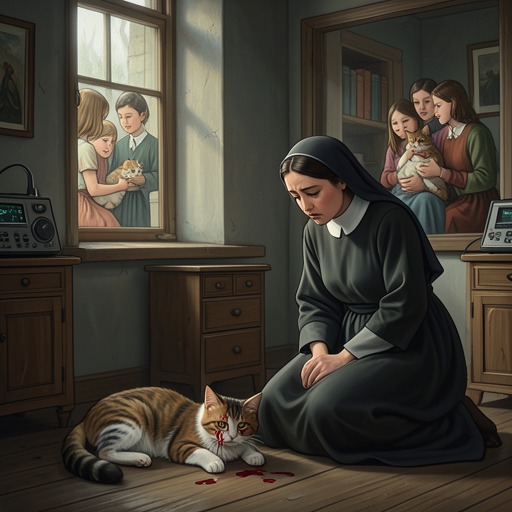
Cleo’s temporary blindness
The StaircaseCleo’s temporary blindness is a brief crisis whose significance lies in the gap between what can be known at the time and what later becomes clear. Cleo is found with an injury to both eyes, and Sister Roberta initially judges that she cannot see. Later, signs that Cleo can track movement complicate that conclusion. In a final recollection, Lizzy Enders restores the sequence: Cleo had been blind, José had hoped she might see again, and attentive care accompanied the possibility of recovery.
Identity and Course of the Condition
The account presents blindness as a condition Cleo experiences for a time, rather than as a settled or permanent state. The evidence establishes a serious problem involving both eyes, but does not identify who caused it, explain the circumstances in which it happened, or specify a medical diagnosis beyond Sister Roberta’s examination. The later observations of Cleo following moving objects make the condition’s duration and change central to the episode.
This distinction matters because the narrative does not treat the first assessment and the later signs as interchangeable. Sister Roberta’s initial judgment belongs to the moment when Cleo is brought to her; the later scene offers different evidence about what Cleo can then perceive. The account’s final return to the earlier day does not erase that change. Instead, it holds together the fact of an earlier blindness and the possibility that Cleo subsequently regained sight.
Injury and Care in the Infirmary
Lizzy Enders finds Sister Roberta working in the infirmary, where Sister Roberta gives Cleo back to her after examining her extensively. She has cleaned Cleo and given her something to quiet her. The examination establishes that both eyes have been struck by a sharp object. The account supplies no further cause or responsible person, so the injury remains a fact without an explanation of how it occurred.
Sister Roberta’s careful examination and practical care frame the episode through attention to Cleo’s immediate needs. The infirmary is where the uncertainty is first addressed: Cleo is examined, cleaned, and given something to calm her, while Sister Roberta communicates her serious assessment to Lizzy Enders. The scene does not offer a lengthy account of treatment or promise a particular outcome. Its importance is the clear record of what Sister Roberta observes and the care she provides before the later evidence changes the picture.
Changing Evidence About Cleo’s Sight
At a later point, Sister Roberta offers a different interpretation. She suggests that something may have happened to Cleo’s eyes in the street, but says Cleo is not blind, referring to how she had chased the curtains in the room the previous night. The curtain episode thus becomes a piece of evidence: Cleo’s behavior appears to show that she can respond visually, even though the earlier examination had led Sister Roberta to a more severe conclusion.
A further observation makes that apparent return of sight more concrete. When yarn is moved, Cleo raises a paw toward its end and follows its movement back and forth with her eyes, which now appear bright and alert. The scene records two linked responses—tracking the yarn and reaching for it—rather than relying only on an uncertain verbal assessment. These actions support the impression that Cleo can see at this later moment, but they do not explain precisely when her sight changed or how the recovery occurred.
Retrospective Meaning and José’s Response
Near the end, Lizzy Enders remembers Sister Roberta handing Cleo back to her months earlier and declaring her blind. Lizzy’s later understanding confirms that the earlier blindness was real; the intervening signs of sight do not make the first judgment mistaken. The retrospective structure therefore resolves the apparent contradiction by placing the observations at different points in Cleo’s course: she had been blind, and later she could see or seemed able to see again.
The memory also recalls José picking Cleo up and examining her in the barn. He does not claim certainty that she will recover; he considers that she might see again and urges Lizzy Enders to love and care for her. That response places care alongside uncertainty rather than presenting recovery as guaranteed. Cleo’s condition remains a particular experience with a beginning, changing evidence, and an apparent improvement, while the story leaves its precise cause and medical course unstated. The later recollection gives the episode its shape: the initial assessment is remembered not as the final word, but as the point from which hope and sustained attention became meaningful.